MUGA done, port installed – two steps closer

I’m on a first-name basis with the woman at the hospital registration desk. She instantly greeted me by name and pulled up my file when I walked in the door yesterday.

It was a busy Tuesday – one heart test and the installation of the mediport.

The MUGA scan was fairly easy. A quick blood draw, a 20 minute wait while a radioactive tracer was mixed with my blood, then I was ushered into the testing room. The blood was injected back into me (now with radioactivity!) and the radiologist placed three heart monitors on my chest.

Then I slid into the machine. It was kind of like an MRI, but MUCH more open and there wasn’t any noise. I could see the monitor showing what was happening in my chest. (The camera uses gamma rays to watch the radioactive tracer move through the heart and get pumped through the body.)

You know when you lie on the grass on a cool summer night and just look up at the stars? And how, if you’re somewhere without much “light noise,” you can see thousands of stars above you? That’s what it looked like on the screen. My body, full of stars.

The whole test lasted about 25 minutes. It was so easy and comfortable, I almost fell asleep, looking at my “stars.” The MUGA is important because a few of the chemo drugs could affect the heart muscle so the docs need to make sure my heart is strong going into chemo AND to get a baseline so my heart can be monitored at different points during my chemo regimen.

I had a few hours before the port installation, so I went home and worked on my syllabi (two done, one to go!). Then back to the hospital.

I had to be there about two hours before my procedure was scheduled. It was a long wait, but I was prepared with one of the books that’s been on my nightstand for way too long. (Gone Girl, reading the book before I see the movie. Really liking the book. Yes, my “for fun” reading is WAY behind the rest of the free world.)

More blood drawn, urine sample to prove I’m not pregnant, an IV of saline and antibiotics started.

Two hours later, I was wheeled to the operating room. This room was a little different from other ORs I’ve been in. This one was designed to use X-rays as part of the surgery to “see” where the port catheter would be placed into a vein in my chest.

More chest monitors, blood pressure cuff and oxygen thing on my finger. Lots of cleaning of the skin and prep of the area (left side, near my collarbone). Then everything turned blue as a drape was placed over my face and right side of my body.

My skin was numbed with a local anesthesia. The nurse pushed a tiny bit of general anesthesia through my IV, and she asked if I wanted more. I declined. I talked to the surgeon and nurses through the whole procedure. I couldn’t feel the incisions (two were made) but could tell when the catheter was winding its way from my collarbone to the middle of my chest. I could feel the doc use a tool to make a “pocket” between my skin and muscle to hold the actual port. I could feel the in and out of the needle as they stitched everything back up.

At this point, the surgeon said he was taking his time to make sure the stitches would heal with minimal scaring. “Doctor,” I said, “I’m having my right boob cut off in a few months. I really don’t think a couple of little scars on the left side will matter much.” (He laughed uncomfortably, but still took his time.)

Because I had so little general anesthesia, I was released less than an hour later.

Two incisions for one port. Yay no more needle sticks!

Two incisions for one port. Yay no more needle sticks! Also, why can’t anyone come up with a nicer hospital gown? Not flattering.

There’s some soreness where the port is placed, but it’s completely manageable with Tylenol. One of the two bandages came off this morning, and everything looks fine. (I covered it with a band-aid – Lalaloopsy, of course – to keep the area as clean as possible.) I just want to be super careful over the next few days because ports placed on the left side can “move” from their original location. The procedure was easy but I’d like to not go through it again until it’s time to remove the port from my body (which won’t be until “everything” is over).

It’s just weird to think I have a triangle-shaped plastic “thing” in my chest now. But it’s also nice to know that needle sticks and IVs are done since everything (except the radioactive MUGA tracer) can be accessed/pushed through the port.

Tomorrow’s supposed to be the MRI. At this point, I’m not sure I want to lay on my stomach for that long with the newly installed port. I may reschedule. This doesn’t not break my heart.

Everything is really, really real now that the gateway for the chemo drugs is in place. I’ll feel better when I get the first round finished on Friday. (Breathe…)
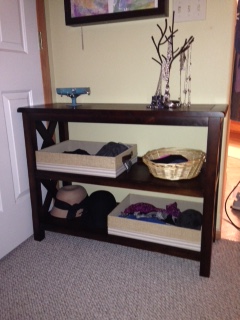
Shopping for my head

Today I tried on “head accessories” – scarves (untied and pre-tied), turbans, and sleep caps. There were two other women in the shop, both had been through chemo – one of them preparing for her third time fighting cancer.

The women were super helpful with what I would need and not need. They talked about the importance of super soft materials and showed me what to look for in the placement of the seams in a turban and pre-tied scarf. They shared how to wash and care for these accessories. They showed some tricks for handling an accessorizing the “tails” of the scarves.

We talked about skin care (probably get really dry) and nail care (could lose my nails but I can still paint them using special polishes, albeit with limited color options – I’m going to miss regular manis-pedis).

I bought several things, and I gained quite a bit of confidence in figuring out how to rock this inevitable bald-thing. It was actually kind of fun trying on stuff. I look pretty damn good in a few of the turbans and scarves… Best estimate, I have 7-21 days after my first treatment before I start losing my hair.

I also got the contact information for the wig fitter/cosmetologist. She has limited hours at the hospital retail shop, but she runs a salon not far from my mom’s. I hope to get an appointment with her this week/early next to help me navigate the world of wigs and how to draw (hopefully) natural-looking eyebrows.

Shopping included looking for somewhere to store all the new stuff for my head. Some assembly required, but this ended up perfect.

Shopping included looking for something to store all the new stuff for my head. Some assembly required, but this ended up perfect.

Tomorrow, I have a heart test (some of the chemo meds can damage the heart so I need baseline results so I can be evaluated over the next few months) and the installation of the mediport (to administer the chemo and have blood drawn through this process).

It’ll be a long day.

Fun story: I tried on one of the pre-tied scarves this afternoon to show the kids. Lauren’s reaction: “Why are you the only one who gets to be a pirate? I want one, too!”

Genetic testing and other news

(Don’t miss the biggest breakthrough at the end of this post…)

On Friday, I met with a genetic counselor to determine whether or not it made sense to undergo testing. I filled out paperwork prior to the appointment, but I was not prepared for the in-depth examination of my family tree.

The counselor was much younger than I expected, probably in her 20s/early 30s. We went through each person in my family, their medical history, current age (or age and cause of death), through my grandparents’ generation. The counselor was looking for any patterns of certain cancers, of which there weren’t any in order to justify testing (even through she said up front that my age at diagnosis was enough to qualify me for testing).

Next came a slide show reviewing basic biology stuff – what’s a cell, where genetic information comes from, likelihood of sharing traits from one generation to the next.

Finally, we got to the reason I was there, discussion of the BRCA 1/2 genes and the testing. There is a significant increase in the likelihood of a person with the BRCA gene to get breast cancer. I’ve seen different stats through my research, but the ones used by the counselor indicated that a woman in the general population (no BRCA link) has a 7-9 percent chance of getting breast cancer. If she carries one of the BRCA genes, that risk increases to 56-83 percent. (Similarly, a man in the general population has less than 1 percent chance of breast cancer, but if he has the gene, that risk increases to 7 percent.)

We talked about how my medical decisions would change based on the knowledge of my BRCA status (I’d have both breasts removed), and how that would affect my future chances of breast cancer. The GREAT news is that I didn’t cry – the first appointment since my abnormal mammogram in which tears were not shed. Most of my tears have been around telling the kids, but now that it’s done, I’m okay.

Then we talked about testing options. Genetic testing is still really new, and there have been significant advances in the last few years. The test can be really expensive ($5,000+) but once someone in the family has it done, if he/she shows any abnormalities in the genes, other family members can get tested for just a few hundred dollars. Their tests would not be as comprehensive, but would only scan the area of the gene with the defect, i.e., if there was a problem with the 1,568th part of my gene, other family members would just have that position examined for a similar problem. So if my test shows a genetic tie to breast cancer, my sister could be screened, and based on her results, my niece could undergo testing as well. (Interestingly, the genetic test cannot be performed on anyone under the age of 18. An individual must decide for him/herself whether or not he/she wants the knowledge. So my kids will have to wait to learn their genetic risks.)

I could opt to JUST know my BRCA 1 and BRCA 2 status. Or, I could opt to know that plus the status of a half-dozen other genes with a cancer influence. With the second option, everything tested has recommended medical guidelines for future monitoring, so if I was positive for a gene that could cause thyroid cancer, I could have proactive screenings and tests to monitor the organ’s health.

There was also a third option: knowledge of just about every cancer-causing gene known. Many of these genes and their cancer-causing links are REALLY new, and there are no established guidelines for monitoring (and therefore, no insurance will cover the cost of proactive care).

I opted for the second test – BRCA status plus a handful of other “known” genes with recognized screening/treatment protocols. After a simple blood draw and two small tubes of blood, I wait for two to four weeks for the result.


In the meantime:

  • Ethan continues to handle the news of my diagnosis and treatment REALLY well. He’s decided he’s going to take a photo a day of me to chronicle this journey. If it helps him cope, I’m in! More than anything I think he’s focused on his own medical news – we learned Friday that he would need surgery to correct a foreskin issue. I was in genetic counseling during his appointment, so my mom went with him. Apparently, when the doc told him the treatment wasn’t working and he’d need surgery, his response was “no.” Ethan and I are looking at two options, and both of us agree that the least invasive one (small incisions versus full circumcision) is worth exploring. I’ve assured him that taking care of this now is for the best and that this will be one of his favorite body parts in the near future. That got us WAY close to, but just shy of, “the” talk.
  • I bought four new hats this weekend. (Yay for winter hat clearance sales!) I’ve watched several tutorials on scarf tying. I’m heading to the hospital wellness center today to talk about wig fitting and other chemo necessities. I can’t believe that treatment starts at the end of the week. I’m ready, but it’s happening so soon. I keep telling myself that there has to be a beginning in order for there to be an end.
  • Major good work news: I was granted a course reduction for the semester, meaning I’ll teach three (instead of four) courses this spring. The rest of my time will be dedicated to student advising, which gives me the flexibility I need for doctor appointments and much-needed rest. (One class on Mondays and Wednesdays, two classes on Tuesday and Thursdays, no classes on Friday.) I had to jump over a couple of pretty big hurdles to get this, but it’s a REALLY big deal. Classes start next week.
  • And I’m saving the biggest news for last… I’ve had three milkshakes since my diagnosis in December. For those who know me, you know this is a GIANT shift in my long-held belief that there’s a frozen treat season, and one should absolutely not consume frozen treats (milkshakes, ice cream/custard/fro yo, frappes, etc.) from Labor Day through Memorial Day. Turns out, milkshakes taste pretty freaking great any time of year. Who knew?!?

Oncology and telling Ethan: things are moving FAST

After the MRI fail this morning, I waited around for one more appointment: the oncologist. Several survivors have told me that the oncologist is a super important part of the medical team, so it’s important to have confidence in the doc.

I checked in (the girls at the desk already know me by name – ugh) and sat in the same seat as last time. Again, I was the youngest by far. And again, the elderly patients were enamored by the TV (“The Chew” this time, not Kelly Ripa).

Suddenly three shrill bells sounded, followed by a message, “Medical emergency in the cancer center, infusion room. Medical emergency in the cancer center, infusion room. Medical emergency in the cancer center, infusion room.” All hell broke loose as 13 (by my count) medical people ran down the hall from all directions. It was about 30 minutes before an old man was taken down the hall to the hospital by gurney.

Soon after I was called by the nurse. We went through my medical history and the same series of questions I answered with the surgeon’s nurse earlier this week. I mentioned that I didn’t make it through the MRI this morning, and she said to make sure to mention that to the doc. The nurse took my vitals (blood pressure was a little elevated, but still within the normal range). When she went to take my temperature via my ear, she gently moved away my hair and said, “Oh, your hair is so pretty!” (I started to tear up.) She explained some of the things I could expect from chemotherapy and some of the recommendations this oncologist usually makes to his patients.

I waited for the doctor after the nurse left. “Fuck, this is an oncologist’s office. I have CANCER,” I thought. This was feeling really REAL. This was the toughest wait I’ve had so far. Oncology is SERIOUS. Surgery I get – cut it off, but chemo is scary.

The doctor came in, and I instantly liked him. He made me feel really comfortable. He asked the basics, then he said, “Do you want to just jump right into this?”

He explained the basics of chemo and how it’s changed over the years. Side effects, like vomiting and nausea, are manageable. He encouraged me to think of chemo as “medicine for cancer” not “poison.” His plan includes two phases prior to surgery: phase one will include Adriamycin (aka “Red Devil”) and Cytoxin (with neulasta to help grow cells lost from the two other meds), one treatment every two weeks (4 treatments total), and phase two will include Taxol and Carboplatin (second one only if my body can tolerate it without dropping my cell counts too low), one treatment each week (12 treatments total). With this schedule, I’m done with chemo by the end of May.

We talked about other chemo side effects like menopause (being in my 40s, instant menopause is very likely), when I’ll lose my hair (about 7-10 days after first treatment) and what I can/can’t do (no birth control pills).

Then he said, “You’ll start chemo next week.”

Back the bus up…WHAT?! (Tears. “Shit’s getting real,” I thought.)

We compared schedules – my class schedule versus his breast clinic schedules at two hospitals. We settled on Friday mornings. I don’t teach on Fridays and that gives me the weekend to recover.

He typed some notes in the computer, placed some orders for necessary pre-chemo stuff (a heart test, installation of a mediport in my chest) and wrote a prescription for lorazapam (to help me get through another attempt at the MRI). And he called the nurse to have a “chemo education session” with me.

“You’re young and healthy. I have no concerns about you in this process. I’m confident you’ll do fine with this,” he said.

The nurse came back in with a book to take home (so much casual cancer reading) and several documents detailing the various medications I’ll receive during chemo and those to manage side effects. We spent another 40 minutes talking about my fears and concerns. She printed a prescription for a wig (that’s weird to type!), we hugged, and I left the cancer center.


First thought when I got in the car: I can’t hide this from Ethan any more. He’ll notice when I start losing hair… I planned the conversation in my head on the drive home. I’ll tell him tomorrow – Ethan and I are spending tomorrow together (he has a doctor appointment so I’m keeping him home from school).

I got home. Mom had already picked up the kids, and Ethan was working on homework in the dining room.

I briefed my mom and told her I had to tell E. A few minutes later, Ethan said he was ready to review his work. I walked into the dining room. “Hey, pal, we need to talk tomorrow,” I said.

“Is it about your boob?” he asked.

“Yeah.”

“Yeah, I know something’s going on. But I don’t want to talk about it tomorrow.”

“Now then?”

I went back to the beginning. I found a lump, went to the doctor, had some images done. “The doctor told me the pictures looked funny,” I explained.

“Funny haha or funny strange?” he asked.

I made a face with my fingers in my ears and my tongue out. “Well, not funny haha. The lumps weren’t doing this. It was more like this,” I said as I made a sad face.

“It would have been funny if the lumps were making the funny face,” he said. Yeah, that would have been funny.

I continued with my explanation: they took samples from the lump with a needle on Christmas Eve, and they called with the results saying it’s cancer. “The good news,” I said, “is that it’s caught super early.”

“It can be cured?” he asked.

“Yep,” I said. “But the doctors need to do a lot to treat it.”

I explained chemo (“medicine for cancer that attacks fast growing cells. Know what other cells besides cancer grow fast? Hair. I’m going to be bald!” He laughed and studied me for a minute. “That’s going to be funny! I’m going to take pictures of you everyday bald!” Sure, kid, whatever floats your boat.)

I explained surgery. He asked, “You’re going to have ONE BOOB?!”

“Maybe,” I said. “They can rebuild it, though.”

“Will it be removable?”

“Maybe. I haven’t decided yet.”

“Wait… Do they rebuild your boob with metal? Will you have metal boobs? Oh! Wait! Super Mom! You’ll have metal boobs that shoot toxic milk!” he said.

He seemed really disappointed to find out my boobs will not be metal. Nor will I shoot toxic milk from my nipples.

“You’re handling this really well,” I said.

“You said that when you told me you were going to start dating. No big deal. You’re going to live another 60 years,” he said.

Nailed it, kiddo. Nailed it. (Well, not the metal boob part… Where that visual came from makes me a little nervous.)

Tomorrow: genetic testing

MRI fail

I was supposed to have an MRI today to get a better look at the two masses and make sure there’s nothing hiding in my “dense” breast tissue. I made it one-third of the way through the procedure, then quit.

The appointment was scheduled for 7 a.m. I like being the first appointment. In and out, I thought. Then I can hang out at Panera, get some work done, and get ready to see the oncologist at noon.

The hospital volunteer took me back to the MRI area right away. I was given a locker for my things and a gown and pants to put on. A few minutes later, I was taken into the MRI room.

(Sidenote: I had an MRI before, when I was about 19 years old. It was for my head, after I started having some strange symptoms which were later diagnosed as atypical migraines. I remember the machine being loud and very tiny, but it wasn’t too bad.)

One of the techs started an IV for a contrast solution which would help show the abnormal tissues in my breast. She tried both arms – my veins are deep and not easy to hit the first time. She finally managed to start it and then asked me to turn over and lie on my stomach.

She moved the pillow I was laying on while she started the IV, and there were two holes. “Your breasts go here,” she said, pointing to the holes. “Forehead here,” while pointing to a C-shaped elevated platform. “Arms outstretched like Superman on this pillow above your head.”

It was wildly uncomfortable. There’s an elevation between the pelvis and the holes for the breasts. It felt really unnatural. The forehead platform was only elevated about an inch and a half, so very little clearance between the tip of my nose and the bed of the machine. (Also, Lauren used my makeup brushes to paint with my hair gel, which I didn’t know until my overly sensitive skin developed a wildly red, itchy rash on my cheeks and forehead. The forehead platform hit all the red itchiness in all the wrong places.) Plus, it was completely uncomfortable with my arms straight out in front of me.

She put headphones on me. (“To help you relax, focus on the music,” she said.) And handed me a cord with a rubber ball at the end. Apparently this was my way of contacting the techs if I had an issue.

Once situated, she moved the bed into the tube. Because of my position, I couldn’t see how close the sides and top of the machine were to my body, but it felt small (even though I wasn’t touching the sides, I was very aware that I was in a small tube with no easy way out.)

Image shows similar position to my test, except the machine at my hospital required me to go into the tube headfirst.

Image shows similar position to my test, except the machine at my hospital required me to go into the tube head first. Also, my tech didn’t look as happy as this woman does. (Image from GE Healthcare)

“I need out,” I said. And she moved the bed out and allowed me to sit up. I asked how long the test would take (30 minutes), and it was reiterated that I couldn’t move at all during the test or the films wouldn’t match up and we’d have to start again. She recommended that I focus on the mirror placed below my eyes in the forehead platform. “You can see outside the machine through this mirror. It’ll make you think you’re in the open!” she said. I thought, well, now you just told me that what I’m seeing in the mirror is a lie and I’m not REALLY out of the machine, so that’s not really going to work…

“OK, 30 minutes. I can do this,” I said. “Put me back in there.”

Music started in the headphones. Country, not my favorite and certainly not necessarily relaxing. The voice of the male tech came over the headphones. “This first one will be about 40 seconds.”

Thunk, thunk, thunk. The process of getting the images sounds like a jackhammer. I tried to think about being in a downtown area, watching the construction of a beautiful building.

It was a very long 40 seconds. I think he lied about the time.

“How are you doing? Next one is five minutes.”

I opened my eyes and saw the mirror of lies. I lifted a finger and could see the image in the mirror. It was about then that I realized it was really hot in the machine. And there didn’t seem to be enough oxygen.

“You can do this. It’s ony 30 minutes. Go back to the construction image,” I tried to tell myself.

More noise and a really long five minutes.

“How are you? This next one is about four and a half minutes.”

“OUT!” I yelled.

“I can’t understand you,” said the male tech.

I repeated, louder. And squeezed the panic ball.

He came in the room to the opening by my head. “If you talk too loud I can’t understand you in there. Are you okay?”

“I can’t breathe very well. It’s hot in here.”

He still couldn’t understand me since I was essentially talking to the mirror below me and I was stuck in this tube.

I lifted my head and felt a glorious cool breeze on my cheeks. I realized the cool air felt great and being in this position did not move my breasts. “OK, let’s just get this over with.”

I thought I could go the rest of the time with my head elevated, but after a few minutes of the next round of images, the cool breeze wasn’t that cool anymore. I was starting to sweat, and it was getting really hard to breathe – like there just wasn’t enough oxygen in this tube.

After the four and a half minutes of the next round of images ended, I cried to get out. “I just can’t,” I said as tears rolled down my face. “I need up. I need a drink of water. I need air.”

The female tech came back in the room and disconnected the IV and helped me sit up. She gave me a Dixie cup of water and a tissue, and she rubbed my back. “This happens a lot,” she said. “We can’t put you totally under for this procedure since you have to lie on your belly, but you can see your doctor for a Valium or something to take the edge off.”

My hands were shaking and I felt weak – physically and mentally weak for not being able to get through this. Both techs assured me that this was one of the hardest MRI tests because of how the body is contorted.

I just wanted to get dressed and leave.

I called my mom and B when I left, and they both made me feel more calm. Writing this is making me calmer. I finally stopped shaking, and my heart isn’t racing anymore. I’m killing time until my oncology appointment at Panera (one of my happy places), enjoying a mocha, and eating a cinnamon bagel. I figure I deserve it.

On the positive side, there was one option (lumpectomy, maybe?) that would have involved undergoing an MRI annually to supplement the yearly mammogram. Yeah, that’s not happening, so my surgical options are sorting themselves out.

EDITED TO ADD: How badly did I want out of the hospital this morning? Two hours after getting dressed post-MRI fail, and I just discovered my pants were on inside out.